Why Your Bike Split Decides Your Run - and How to Pace It
Quick Answer: A run that collapses in the first two kilometres is nearly always a bike pacing problem, not a running one. Riding above your sustainable intensity depletes glycogen and accumulates fatigue that only becomes visible once you start running. For an olympic-distance race, target roughly 75 to 80 percent of your functional threshold power on the bike, keep the first 10 minutes deliberately easy, avoid surging on hills, and take 60 to 90 g of carbohydrate per hour. The bike is where the run is won.
Here is how to pace it, and how to train the transition so the legs cooperate.

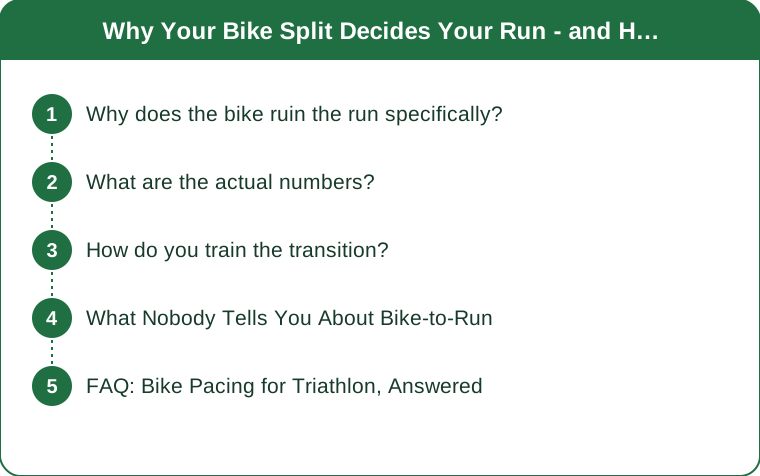
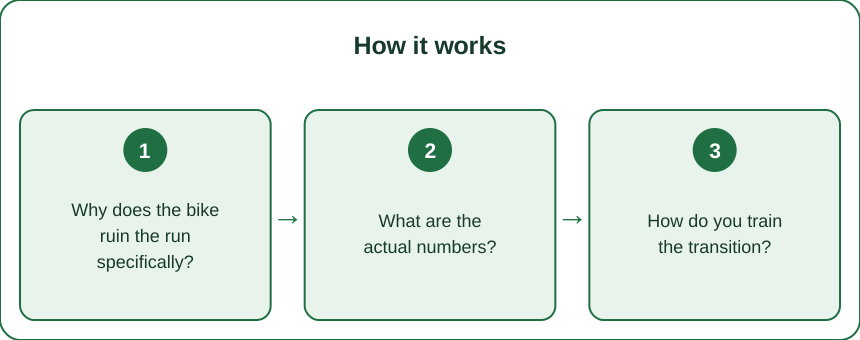
Why does the bike ruin the run specifically?
Because the cost of riding too hard is deferred, not immediate. Above threshold intensity you draw disproportionately on glycogen and accumulate metabolic fatigue, but on the bike your body is supported and you feel capable. The bill arrives when you stand up.
Running is far less forgiving of fatigue than cycling is. On the bike the frame carries you and you can freewheel. Running requires you to support and propel your entire bodyweight on every single step.
Glycogen depletion is the main mechanism. Riding 10 percent too hard for 90 minutes can leave you meaningfully short for a 10 km run, and there is no way to make that up once you are running.
Muscle recruitment differs, which magnifies the effect. Cycling is quad-dominant with limited hip extension; running needs hamstrings, glutes, and calves working elastically. Tired quads with cold hamstrings is exactly the sensation of the first kilometre.
Surging costs more than steady effort at the same average. Repeated hard efforts on hills or into wind carry a disproportionate metabolic penalty, which is why a variable ride at the same average power is far more expensive than a steady one.
And the last 15 minutes matter most. Riding hard right up to transition leaves nothing for the first kilometre, which is precisely when you need the most control.
What are the actual numbers?
For olympic distance, target 75 to 80 percent of FTP as normalised power across the bike leg. Going to 85 percent feels sustainable at the time and routinely costs several minutes on the run.
For sprint distance, 80 to 85 percent is workable because the run is short enough to survive a deeper bike.
For half-distance, drop to 70 to 75 percent. The longer the race, the more the run punishes an aggressive bike, and the wider the gap between what feels fine and what is sustainable.
Ride the first 10 minutes below target, deliberately. Coming out of the swim your heart rate is high and your perception of effort is unreliable. Ten easy minutes costs seconds and saves minutes.
Cap hill efforts at about 110 percent of your target power, even on steep sections. Losing 15 seconds on a climb is trivial; the metabolic cost of a 150 percent surge is not.
Aim for 60 to 90 g of carbohydrate per hour on the bike and start within the first 15 minutes. The bike is the only leg where you can absorb meaningful fuel comfortably, so it has to carry the nutrition for the whole race.
Drink 500 to 750 ml per hour, adjusted for heat. Dehydration on the bike shows up as a run problem, exactly like everything else here.
And spin the last 5 minutes at high cadence and low resistance. It flushes the legs and eases the muscular transition to running more than any stretching at transition does.

How do you train the transition?
Do brick sessions weekly - but the short run matters more than the long ride. A 15 to 20 minute run immediately off the bike trains the specific adaptation; adding it to a long ride is optional.
Practise the first kilometre at target race pace, not faster. Most athletes run the first kilometre off the bike too fast because their legs feel odd and they try to run through it. Rehearsing the correct pace is the point of the session.
Raise your bike cadence in the final kilometres to 90 to 95 rpm. Higher cadence, lower force reduces the muscular fatigue you carry into the run, and it is a habit worth building in training.
Do some brick runs on tired legs deliberately. Once every few weeks, run off a genuinely hard ride so you know what the worst case feels like and have a plan for it.
Train your gut alongside your legs. Taking 60 to 90 g of carbohydrate per hour requires practice, and race day is the wrong place to discover your tolerance.
Rehearse transition itself. Practising shoe changes and dismount removes 30 to 60 seconds and, more importantly, removes the frantic start that makes people run the first kilometre far too hard.
And keep a power or heart-rate cap on race day rather than a target. A ceiling is a discipline; a target invites you to chase it in the first excited half hour.
What Nobody Tells You About Bike-to-Run
The heavy-legs feeling passes in about 5 to 10 minutes for most athletes, provided you have not overcooked the bike. Knowing that stops the panic that causes overpacing in kilometre one.
Your running cadence drops off the bike without you noticing. Deliberately running at a slightly higher cadence for the first kilometre counteracts it and smooths the transition considerably.
Aero position tightness affects the run more than people expect. Long periods in an aggressive position shorten the hip flexors, which limits stride extension immediately afterwards. Standing and stretching briefly late in the ride helps.
Nutrition taken in the last 15 minutes of the bike lands during the run, which is a genuinely useful window most athletes waste.
Pacing errors compound with distance. Riding 5 percent too hard costs perhaps a minute over a sprint and can cost ten over a half. The longer the race, the more conservative the bike should be.
Wind matters more than gradient for pacing discipline. Riding into a headwind at constant speed means riding at constant overexertion, and holding power rather than speed is the correction.
And the athletes who negative-split the run are almost always the ones who under-rode the bike. It is the least glamorous way to race well and the most reliable.
FAQ: Bike Pacing for Triathlon, Answered
What power should I ride at for olympic distance?
Roughly 75 to 80 percent of FTP as normalised power. Riding at 85 percent feels sustainable during the ride and typically costs several minutes on the run.
Why do my legs feel awful for the first kilometre of the run?
Cycling is quad-dominant with limited hip extension, so hamstrings and calves start cold. The sensation usually passes within 5 to 10 minutes if the bike was paced correctly.
How much should I eat on the bike?
60 to 90 g of carbohydrate per hour, starting within the first 15 minutes. The bike is the only leg where you can comfortably absorb meaningful fuel.
Should I push hard on hills?
No - cap efforts at about 110 percent of target power. Losing 15 seconds on a climb is trivial next to the metabolic cost of a large surge.
How often should I do brick sessions?
Weekly, with a 15 to 20 minute run off the bike. The short run is what produces the adaptation; a long ride beforehand is optional.
What should I do in the last five minutes of the bike?
Spin at high cadence with low resistance to flush the legs, and take on nutrition that will land during the early run.
Should I target a power number or set a cap?
Set a cap. A target invites chasing in the excited first half hour, whereas a ceiling is a discipline you can hold when adrenaline is high.
Why do I fade at the same point every race?
Most commonly because the bike is being ridden at a similar excess each time. Reduce bike intensity by 5 percent in your next race and compare the run split - the answer is usually immediate.
TL;DR:
- Run collapses are bike pacing errors, deferred. Riding above sustainable intensity costs glycogen you need later.
- Olympic: 75 to 80 percent of FTP. Sprint: 80 to 85. Half: 70 to 75.
- First 10 minutes deliberately easy - post-swim effort perception is unreliable.
- Cap hills at 110 percent of target. Surges cost far more than the seconds they save.
- 60 to 90 g carbohydrate per hour, starting within 15 minutes, plus 500 to 750 ml fluid.
- Spin high cadence for the last 5 minutes to flush the legs before transition.
- Weekly bricks with a 15 to 20 minute run, practising race pace rather than running through the heaviness.
Set a power cap, not a target. The athletes who negative-split the run are the ones who under-rode the bike.
Keep Reading
This article is for general informational and styling purposes only. Fit, sizing, and product availability may vary.