Why Taper Week Feels Worse Than Training — and What to Change
Quick Answer: Taper week feels bad because reduced volume disturbs a routine your body has adapted to — heavy legs, restlessness, poor sleep, and phantom niggles are all normal and none of them predict race performance. The two changes that help most: keep the intensity while cutting the volume, and hold your training schedule’s timing even as sessions shrink, so your daily rhythm does not collapse along with the mileage.
Everything you read says the taper is where the fitness arrives. Then you get there and your legs feel like they are full of sand and you are convinced you have lost everything.
This is so common it is close to universal, and there are specific reasons for it.

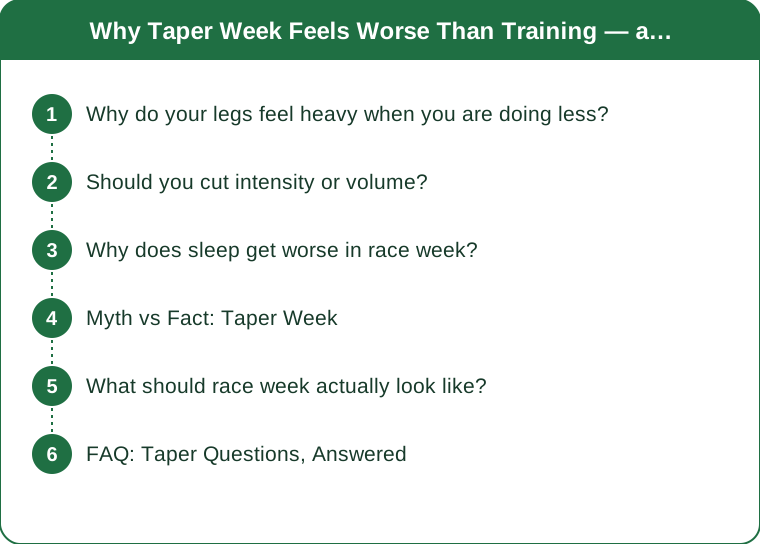
Why do your legs feel heavy when you are doing less?
Several things happening at once, none of them a loss of fitness.
Fluid and glycogen shifts. As volume drops and you eat normally, muscle glycogen stores refill — and glycogen is stored with water, roughly 3 grams of water per gram of glycogen. That is a real increase in muscle water content and it genuinely feels heavier. It is also exactly what you want on race day.
Loss of the daily flush. Regular training keeps blood flow and lymphatic movement high. Cut the volume and that daily circulation drops, which many athletes perceive as stiffness.
Repair happening. Reduced load means the accumulated micro-damage from a training block is finally being repaired rather than added to. Repair processes are not comfortable.
Attention. With fewer sessions and more nervous energy, you notice sensations you would have run straight past in week six. The niggles were probably always there.
Should you cut intensity or volume?
Volume. Keep the intensity. This is the most consistent finding in the taper literature and the most commonly ignored one.
The pattern that works:
- Reduce total volume by roughly 40 to 60 percent across the taper period
- Keep the frequency — same number of sessions, each shorter
- Keep race-pace intensity in short, sharp doses
The reasoning is that intensity maintains the neuromuscular qualities and the metabolic sharpness that fade fastest, while volume is the fatigue driver. Cut the fatigue, keep the sharpness.
What goes wrong when people cut intensity too: legs feel flat and unresponsive on race day, and the first hard effort feels alien. A few short efforts at or near race pace on each of the last few days keeps the system awake without adding fatigue. Think minutes, not miles.
Why does sleep get worse in race week?
Anticipation plus a disrupted routine, and both are addressable.
Reduced training means less sleep pressure. Training volume is a major driver of sleep drive. Cut it sharply and you have genuinely less of the physiological push toward sleep, at exactly the moment nerves are increasing.
Nerves rise as the race approaches, with elevated evening arousal that runs directly against falling asleep.
Schedule disruption. If your 6am swim disappears, your whole day shifts and your body clock loses an anchor.
What to do:
- Hold your training schedule’s timing even as sessions shrink. Same wake time, same session slots, shorter sessions.
- Prioritise the two nights before the two nights before. Sleep two nights out matters more than the night before, and nearly everyone sleeps poorly the night before a race regardless.
- Do the race-morning logistics early in the week. Bag packed, route planned, timings written. Same principle as any anticipation problem — unresolved tasks keep the loop running.

Myth vs Fact: Taper Week
Myth: Feeling bad in the taper means the taper is not working. Fact: Feeling heavy and restless during a taper is close to universal and does not correlate with race outcome. Athletes who feel fantastic all taper week are the unusual ones.
Myth: You should do nothing for the last few days. Fact: Complete rest generally produces worse performance than a reduced-but-active taper. The frequency of sessions matters, even short ones.
Myth: An extra session will help if you feel like you have lost fitness. Fact: Fitness gained in the last ten days is negligible; fatigue gained is not. Nothing you add in race week helps, and several things you could add will hurt.
Myth: Carb loading means eating enormous amounts. Fact: For most age-group athletes it means a moderate shift in composition over the final day or two, not volume. Overdoing it produces gut distress on race morning, which is the most common self-inflicted race problem there is.
Myth: Your race-week weight gain is a problem. Fact: One to two kilos from glycogen and its associated water is expected and is a sign the taper is working exactly as intended.
What should race week actually look like?
A workable structure for a sprint or Olympic distance:
- Monday: short easy session in your weakest discipline, plus a few race-pace efforts
- Tuesday: short bike with 4 to 6 short efforts at race intensity
- Wednesday: easy swim, technique focus, nothing hard
- Thursday: short brick — 20 minutes bike, 10 minutes run, a couple of minutes at race effort
- Friday: full rest or a very easy swim. Bike checked and packed. Bag laid out.
- Saturday: 15 to 20 minutes easy with two or three 30-second pickups. Travel, registration, early night.
- Sunday: race.
The things that genuinely matter in race week are all logistical: bike mechanically checked early enough to fix anything, nutrition rehearsed rather than improvised, transition layout practised, and nothing new tried. Not the kit, not the gel, not the breakfast.
This is general information, not medical or coaching advice specific to you. If you are working with a coach, their plan beats a generic one every time.
FAQ: Taper Questions, Answered
How long should a taper be?
For sprint and Olympic distance, roughly 7 to 10 days. Longer races want longer — two weeks or more for half and full distance. Shorter tapers suit shorter races and athletes with lower training volumes.
I got sick during my taper. What now?
Common, and partly because the drop in training load coincides with the immune stress of a hard block. Rest genuinely and reassess two days out. Racing with a fever is a bad idea regardless of how much the entry cost, and symptoms below the neck are the usual line for not starting.
Should I still do my strength sessions?
Drop the heavy loading about ten days out. Keeping some very light movement can help you feel normal, but nothing that produces soreness. If in doubt, leave it out — there is no strength gain available in race week and there is plenty to lose.
TL;DR:
- Heavy legs in the taper come from glycogen refilling with water, reduced daily circulation, and repair — not lost fitness.
- Cut volume by 40 to 60 percent, keep frequency and keep race-pace intensity in short doses.
- Sleep suffers because training-driven sleep pressure drops as nerves rise; hold your schedule’s timing and settle logistics early.
- Nothing new in race week — not kit, not nutrition, not an extra session.
Expect to feel worse before you feel fast. It is the taper working, not failing.
Keep Reading
This article is for general informational and styling purposes only. Fit, sizing, and product availability may vary.