Why September Open Water Feels Colder Than the Thermometer Says
Quick Answer: Late-summer water is usually at or near its annual peak, but the air above it is not. When the air is colder than the water, everything outside the swim gets harder - the pre-swim wait, the exit, the transition - and that is where most of the cold experience actually happens. Add darker, earlier starts, wind on wet skin, and the fact that your body has finished acclimatising to heat rather than cold, and a 68F lake in September feels considerably worse than the same 68F felt in July.
The app says the water is a degree warmer than your best swim in June.
You still stood on the bank for four minutes rehearsing reasons to go home.
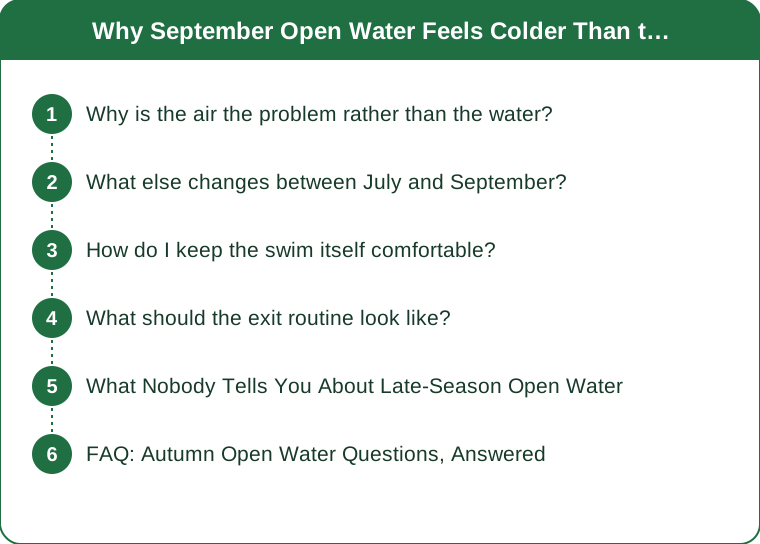
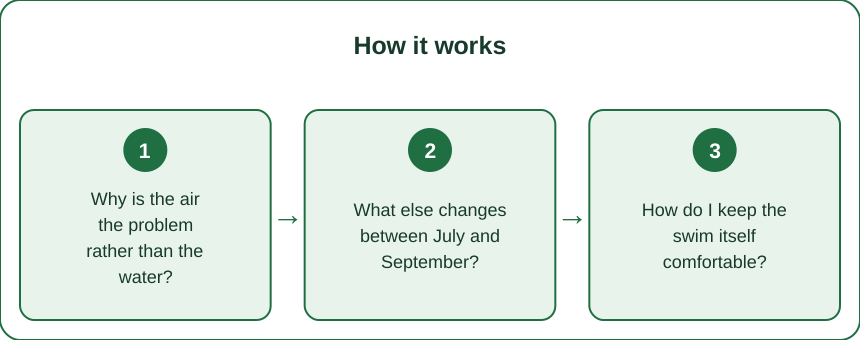
Why is the air the problem rather than the water?
Water lags air by weeks. Lakes and seas reach peak temperature in late summer, well after the air peaked, and they cool slowly through autumn.
So in September the water is often warmer than the air above it, which reverses the summer relationship entirely.
Cold air on wet skin evaporates fast, and evaporative cooling removes heat far more efficiently than still air ever does.
The dangerous part of an autumn swim is the ten minutes after it, not the swim, because you exit soaked into air that is colder than what you just came out of.
Pre-swim standing around is the second problem, since arriving cold means you start the swim already down on core temperature.
Which means most of the fix is about the land portion of the session, not the water portion.
What else changes between July and September?
Wind matters more. Autumn is windier in most regions, and wind on wet neoprene multiplies heat loss on exit.
Starts are earlier and darker, which means air temperature at the water is often at its daily minimum when you get in.
Your acclimatisation has gone the wrong way. A summer of heat adaptation improves sweating efficiency, which is exactly the wrong adaptation for cold water.
Water clarity typically drops with late-season algae and turnover, and reduced visibility raises anxiety, which raises the perception of cold.
Daylight for a safe swim shrinks quickly, compressing sessions into narrower windows.
And there are fewer people at the water, which matters for safety as much as for morale.
How do I keep the swim itself comfortable?
Warm up on land before getting in. Five minutes of arm swings, jogging and band work raises core temperature and reduces the initial shock response.
Get the face wet deliberately before starting, which blunts the cold shock response - the involuntary gasp is a facial-immersion reflex, and pre-exposing to it works.
Add neoprene at the extremities first. A neoprene cap, then booties, then gloves - the head, hands and feet lose heat disproportionately and are cheap to insulate.
Two swim caps with the neoprene one on top is the low-cost version and makes a real difference.
Start slower than you want to. Sprinting into cold water raises breathing rate and makes the first few minutes far harder to control.
And swim closer to shore as the season turns, running parallel rather than out and back, which changes the safety picture significantly for the same distance.
What should the exit routine look like?
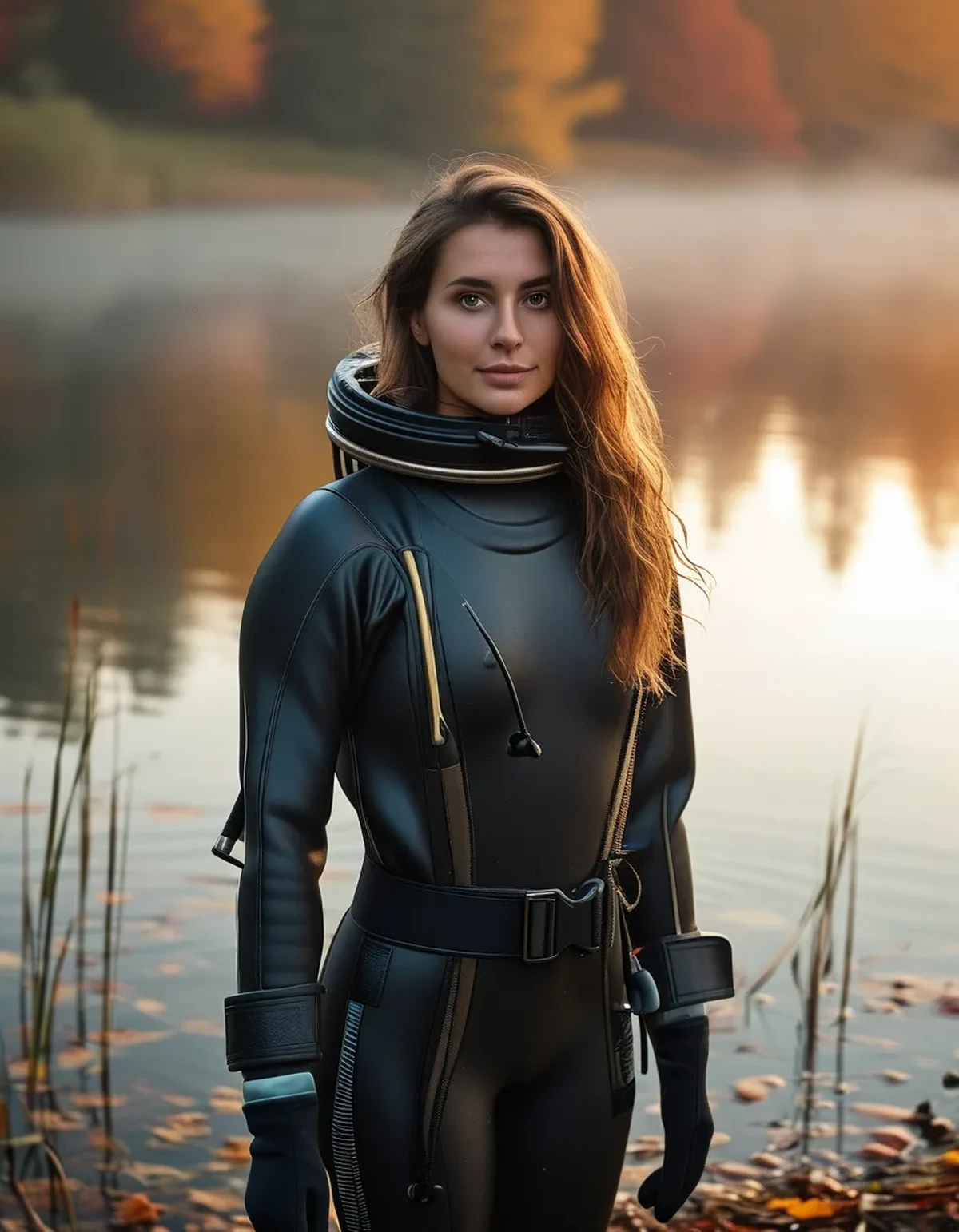
Have everything laid out before you get in, so nothing requires decisions or fine motor control afterwards - cold hands cannot manage zips and buckles.
Get the wetsuit off immediately, since wet neoprene in wind is worse than no neoprene, and standing around in it is the classic mistake.
Dry the head first. It is the fastest heat loss route and a warm hat on immediately makes an outsized difference.
Layer up before you feel cold, not after. Core temperature keeps dropping for a while after you exit, which is why people who feel fine at the car are shivering ten minutes later.
Warm drink in a flask, more for the psychological and behavioural effect than the thermal one, though it helps.
And do not drive until you have stopped shivering hard, since dexterity and reaction time are genuinely affected.
This is general information, not medical advice.
What Nobody Tells You About Late-Season Open Water
Afterdrop is the part that catches experienced swimmers. Core temperature continues to fall for 10 to 20 minutes after you exit, as cold blood from the limbs returns to the core. This is why the moment of feeling worst is usually in the car park, not in the water, and why layering up immediately matters more than how you felt on exit.
Acclimatisation is real and it is fast. Regular exposure - even two or three short swims a week - noticeably reduces the cold shock response within a few weeks. Swimmers who continue through September and October handle 60F far better than someone arriving at it fresh in November. Skipping three weeks costs a surprising amount of that adaptation.
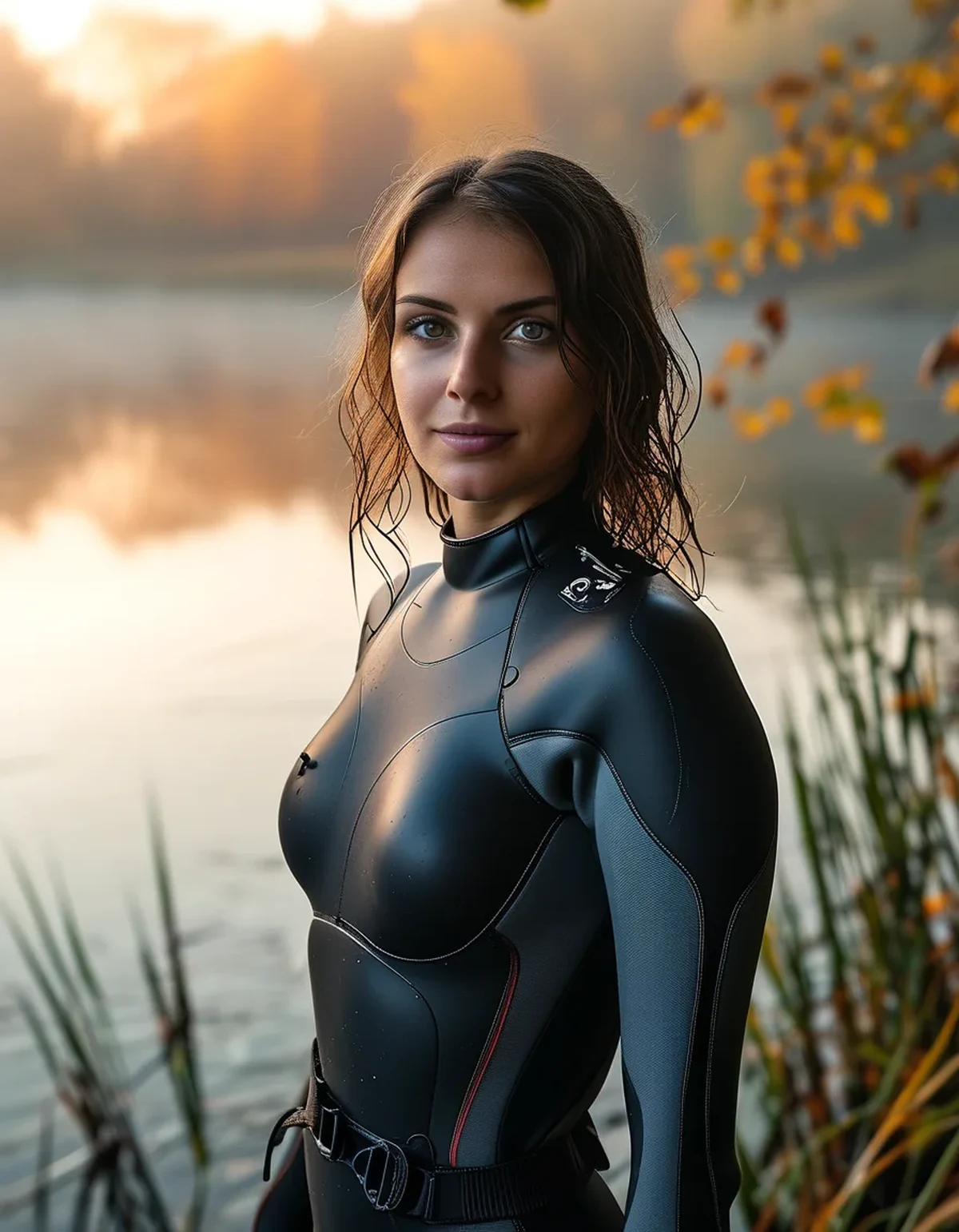
Wetsuit thickness is the smaller variable, fit is the bigger one. A well-fitted 3:2 keeps you warmer than a loose 4:3, because a loose suit flushes cold water through the gap with every stroke. The neck and wrist seals do most of the work.
The season ends for a different reason than people expect. Most swimmers stop because of the exit conditions and the daylight, not because the water became intolerable. Solving the exit routine and the timing often extends a season by six weeks.
Alcohol afterwards is a genuinely bad idea. It promotes peripheral vasodilation, which accelerates heat loss at precisely the point core temperature is still falling. The post-swim pint is a tradition worth delaying until you are properly warm.
And never swim alone as the season turns. The margin for a cramp, a cold shock response or an equipment problem narrows considerably in cold water, and the number of other people around the water drops at the same time. A swim buddy is standard practice for a reason.
FAQ: Autumn Open Water Questions, Answered
What water temperature needs a wetsuit?
Most triathlon rules make wetsuits mandatory below roughly 60F and optional in a band above it. For training, most people want one below about 68F once the air is cool too.
How do I stop the gasp when I get in?
Get the face wet first, enter gradually rather than diving, and breathe out slowly. The response fades within about 90 seconds of controlled breathing.
Is a neoprene cap worth it?
One of the best value items for autumn swimming. Head heat loss is significant and a neoprene cap addresses it directly.
How long can I safely swim as it cools?
It depends on temperature, suit and adaptation. A common approach is one minute per degree Fahrenheit below 70 as a rough starting ceiling, adjusted by experience and always with company.
Why do my hands go numb before anything else?
Peripheral vasoconstriction shunts blood to the core, and hands lose dexterity early. Neoprene gloves fix it and are worth the small drag penalty in training.
When should I stop for the season?
When the exit conditions stop being manageable rather than when the water hits a number. If you cannot get warm within 20 minutes of exiting, that is the signal.
This is general information, not medical advice.
TL;DR:
- Water peaks weeks after the air, so in September the lake is often warmer than the air above it.
- Most of the cold experience happens before and after the swim - the wait, the exit, the wind on wet skin.
- Warm up on land, wet the face first, and add neoprene at the head, hands and feet.
- Afterdrop keeps core temperature falling for 10 to 20 minutes after exit - layer up immediately, not when you feel cold.
- Fit beats thickness in a wetsuit, and consistency beats toughness in acclimatisation.
The water did not get colder. Everything around it did.
Keep Reading
This article is for general informational and styling purposes only. Fit, sizing, and product availability may vary.