Triathlon Brick Workouts: The Key Training That Prepares You for Race Day
Quick Answer: A brick workout is two triathlon disciplines back-to-back — almost always bike then run, with a transition of under two minutes. It trains your legs and your head for the heavy, unstable feeling of running off the bike. Run roughly one brick a week, start with 10-15 minutes of running after your ride, and build from there.
You finish the bike leg feeling strong. You rack the bike, start running, and your legs belong to someone else entirely — heavy, wobbly, running at a pace that feels fast and isn’t.
Every triathlete meets this. The ones who’ve done brick workouts meet it in training, shrug, and keep going. The ones who haven’t meet it at kilometre one of the run leg on race day, and it’s a considerably worse place to find out.

What Is a Brick Workout and Why Does It Matter?
A brick is two disciplines trained back-to-back with minimal rest — most commonly bike, then run immediately.
Why the legs feel strange: you’ve spent 40+ minutes in a fixed position, pedalling in a narrow range of motion with your quads doing most of the work. Then you ask the same legs to extend fully, absorb impact, and use your hamstrings and calves in a completely different pattern. Blood distribution, muscle recruitment, and neuromuscular coordination all have to switch over at once.
The heavy, disconnected feeling typically lasts 5-15 minutes, then eases as your body adapts to the new demand.
What bricks actually train:
- Physical adaptation. The transition gets less disruptive each time you rehearse it. The jelly-leg phase shortens.
- Pace calibration. Off the bike, your perceived effort lies to you — a 6:00/km feels like 5:00/km. Bricks teach you what your real race pace feels like in that state.
- Mental preparation. Knowing the sensation is normal and temporary is worth a lot when you’re 500m into a run leg and everything feels wrong.
That last one is why bricks are widely considered the highest-value session in triathlon training.

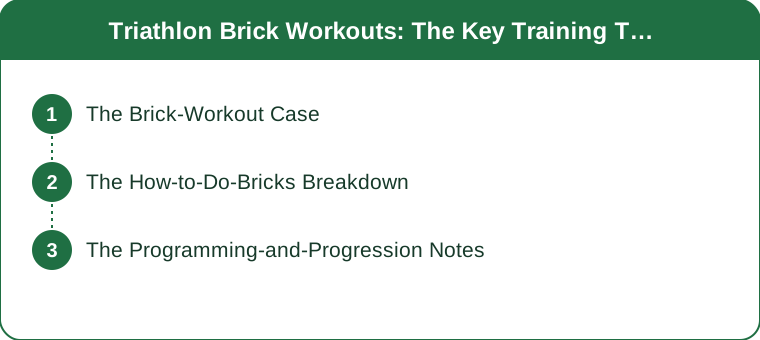
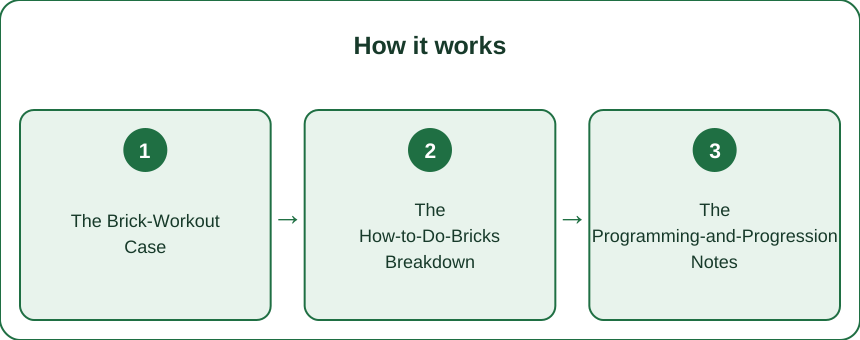
How Do You Do a Brick Workout?
Keep the transition short. Under two minutes, ideally under one. A long gap lets your legs recover, which defeats the point. Have your running shoes laid out ready before you leave on the bike.
Practise the actual T2 routine. Rack the bike, helmet off, shoes swapped, go. Rehearsing the sequence saves real time on race day and removes fumbling from an already disorienting moment.
Start short. Your first bricks should be 10-15 minutes of running after a normal ride. That’s enough to experience the sensation without wrecking you.
Build gradually. Progress the run portion by 5 minutes every couple of weeks. A sprint-distance athlete might build to 20-25 minutes; an Olympic-distance athlete toward 30-40.
Practise at race effort, not harder. The purpose is calibration. Ride at your intended race power or perceived effort, and run at your intended race pace. A brick done flat-out teaches you nothing about pacing.
Use your race gear. Same shoes, same socks, same nutrition, same elastic laces. Bricks are the place to discover that a particular sock rubs — not on race day.
Swim-to-bike bricks exist too, and they’re worth doing a couple of times before a first race, mainly to practise T1 and get used to riding with a slightly disoriented head.
5 Mistakes Everyone Makes With Brick Workouts
- Doing them too often. Bricks are demanding and carry more fatigue cost than either discipline alone. Roughly one per week is the standard recommendation; two is plenty even in a peak block. Every ride does not need a run attached.
- Taking a long transition. Ten minutes of faffing means you’ve done a bike session and a separate run session. The discomfort is the training stimulus.
- Running too fast off the bike. Your legs are compromised and your effort perception is skewed. Going hard here produces a bad session and often a niggle. Race effort, not race-plus.
- Skipping the gear rehearsal. People do twelve bricks in old trainers and then race in new ones. Every equipment variable should be tested in a brick first.
- Not recovering afterward. A brick is a hard session. Treat the following day as easy or off, and don’t stack it next to your other key workout of the week.
How Should You Program Bricks Into a Plan?
Frequency: about once a week during the build phase. Skip them in early base training — you don’t need them until race-specific work begins.
Placement: treat it as a key session. Put it where you’re relatively fresh, with an easy day after.
Progression: hold the bike portion roughly constant and grow the run portion. Once the run reaches race distance, start increasing the intensity of the bike leg instead.
Race simulation: do one full-rehearsal brick 2-3 weeks out — race-distance bike, race-distance run, race nutrition, race kit, race-morning breakfast. Then taper. Don’t do a big brick in the final ten days; there’s nothing left to gain and plenty to lose.
For a first triathlon: four to six bricks across your build is genuinely enough to remove the surprise. You don’t need to be sophisticated about it — you just need to have felt it before.
Mini FAQ
How long should a brick workout be?
For sprint distance, something like a 30-45 minute ride followed by a 10-20 minute run. For Olympic distance, 60-90 minutes on the bike and 20-40 minutes running. The run portion is the variable you progress; the bike is the setup.
Why is it called a brick?
The most common explanations are that your legs feel like bricks off the bike, and that it stands for Bike-Run-Ick. Nobody agrees, and both are accurate enough in the moment.
Do I need to do swim-bike bricks?
They’re less essential than bike-run, but doing two or three before your first race is useful — mostly to practise T1 and get comfortable with how your head feels on the bike straight out of open water.
TL;DR:
- A brick is bike-then-run back-to-back with a transition under two minutes.
- The heavy-leg feeling lasts 5-15 minutes and shortens with practice — that adaptation is the point.
- Start with 10-15 minutes of running off the bike and build by ~5 minutes every couple of weeks.
- Run one brick a week during the build phase, at race effort, in full race gear.
- Do a full race-simulation brick 2-3 weeks out, then leave them alone during the taper.
Keep Reading
This article is for general informational and styling purposes only. Fit, sizing, and product availability may vary.