The Eight Weeks After Your Last Race Decide Next Season
Quick Answer: The eight weeks after your final race of the season should run in three stages: one to two weeks of genuine rest with no structure, three to four weeks of unstructured aerobic play plus the beginning of a real strength habit, and two to three weeks of rebuilding a light routine that leads into winter base. The purpose is not fitness. It is repairing the accumulated fatigue, fixing the limiter you spent all season working around, and arriving at winter base training actually wanting to train.
Do the boring thing now and next June is a different season.

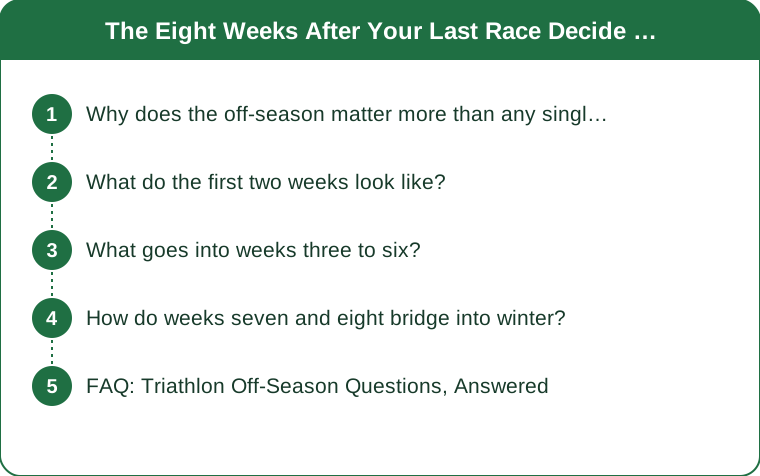
Why does the off-season matter more than any single training block?
Because it is the only time you can address what is actually holding you back.
In-season, everything defers to the race calendar. Every weakness gets managed rather than fixed, because there is never a moment when a temporary dip in performance is acceptable. The off-season is that moment, and it comes once a year.
Accumulated fatigue is real and slow to clear. A full season of training and racing produces deep fatigue that a rest week does not resolve. Sleep quality, motivation, resting heart rate, and mood are usually better indicators of it than any performance test.
Motivation is a trainable resource too. Athletes who go straight from their last race into winter base training are the ones most likely to lose interest in February. A genuine break is a performance intervention, not a character flaw.
And the injury you have been managing all season has a window. Niggles that were tolerable at race volume are far easier to resolve when the volume is low and the calendar has no deadlines.
What the off-season is not: it is not eight weeks on the sofa, and it is not a quiet continuation of race training with the intensity slightly lowered. Both are common and both waste the window.
What do the first two weeks look like?
Almost nothing, deliberately.
Take one to two weeks with no structured training at all. Not reduced training. None. Move if you feel like it — walk, hike, swim casually, ride to a coffee shop — and do not follow a plan or record a session.
This is where the deep fatigue clears. Two weeks of complete rest costs very little fitness in absolute terms, and it resolves fatigue that eight weeks of easy training would not.
The fitness loss is smaller than it feels. Aerobic adaptations built over a season decay slowly at first. Two weeks off produces a modest dip that returns within a couple of weeks of restarting, and the freshness gain outlasts the loss.
Expect to feel terrible for a few days. Many athletes feel flat, achy, or unusually tired in the first days of a break. That is the accumulated load surfacing once the stimulus stops, and it is a sign the break was needed.
Handle the admin now. Book the physiotherapy assessment for that nagging issue, get the bike serviced, replace the shoes you have been squeezing another month out of, and get any health checks done.
Eat normally. Appetite often stays high for a week or two after training stops. Reducing intake aggressively at exactly the moment your body is repairing tissue is counterproductive, and body composition is a winter project, not a recovery-week one.

What goes into weeks three to six?
Unstructured aerobic work, and the strength habit you never had time for.
Train by feel with no plan. Ride because the morning is good, swim because the pool is empty, run in the woods because the leaves are turning. No intervals, no target paces, no session names. Aerobic exposure without prescription.
Do other sports. Hiking, mountain biking, climbing, court sports, a yoga class. Movement variety loads tissue in patterns that season-long repetition never touches, and it is the most effective thing you can do for the small chronic complaints that come from doing three sports in straight lines.
Start strength training properly, this week, not in January. This is the single highest-value off-season item for most triathletes:
Two sessions a week, full body, compound movements. Squat or split squat, hinge or deadlift, a push, a pull, and direct core work.
Start absurdly light and add gradually. Two to three sets of 8 to 12 reps at a weight you could clearly do more with, for the first three weeks, then begin adding load. The first weeks are about movement quality and tendon tolerance, not stimulus.
Expect real soreness the first fortnight and do not panic about it. It settles quickly, and it is a poor guide to whether the session was useful.
Fix the limiter you avoided all season. For most age-group triathletes that is swim technique. Off-season is when you can afford weeks of drills that make you temporarily slower, and a technique block now is worth more than any amount of hard swimming in May.
Address the injury properly. Rehabilitation needs consistency and load management, and both are available now.
How do weeks seven and eight bridge into winter?
You rebuild routine and consistency, not fitness.
Return to a light weekly structure. Fixed days, sensible durations, still mostly easy. The goal is that training is a habit again by the time base training officially starts, so week one of the winter plan is not also week one of getting out of bed early.
Keep intensity low and let duration creep. A little added time each week, all of it comfortable. Winter base is built on aerobic volume, and this is the on-ramp.
Add a small amount of intensity late, if at all. A few short strides or a handful of brisk efforts at the end of an easy session. Not intervals. The purpose is to keep the neuromuscular system awake, not to train.
Keep the strength sessions and start progressing them. By now the soreness has settled and load can climb steadily. Strength gains built through winter are what protect you through next season’s volume.
Do the season review before you plan the next one. Honestly: what limited you, what worked, which sessions you dreaded, where you lost time in races. Transitions and pacing errors cost most age-group triathletes more time than fitness does, and both are cheap to fix.
Then pick next year’s races and work backwards. An A race, one or two B races, and a plan that starts from where you actually are.
Watch for the two failure modes. Extending the unstructured phase indefinitely until January arrives with no base, or getting so enthusiastic in week three that you are effectively training hard by week five. Both are extremely common, and the calendar dates you write now are the main defence against them.
This is general training guidance, not medical advice. Persistent fatigue that does not lift with rest, or pain that worsens under light activity, is worth getting assessed by a professional.
FAQ: Triathlon Off-Season Questions, Answered
Will I lose all my fitness if I take two weeks completely off?
No. Aerobic fitness declines slowly at first and the small dip returns within a couple of weeks of restarting. The clearing of accumulated fatigue is worth far more than the fitness you temporarily give up.
When should I start strength training?
Week three, right after the complete break. Starting in January means the hardest adaptation weeks land in the middle of base building, which is exactly when you do not want to be sore.
Should I keep swimming through the off-season?
Yes, ideally, because swim feel decays faster than bike or run fitness. Make it technique-focused rather than fitness-focused, which is the best use of a period with no races.
How do I know the break was long enough?
When you find yourself wanting to train rather than deciding to. If motivation has not returned after two weeks, that is information worth taking seriously rather than overriding.
TL;DR:
- Weeks one to two: complete rest, no structure, no logging. This clears fatigue nothing else clears.
- Weeks three to six: unstructured aerobic play, other sports, and start a real twice-weekly strength habit.
- Weeks seven to eight: rebuild a light routine and let duration creep so winter base starts with a habit already running.
- Use the window to fix the limiter — usually swim technique — and the injury you managed around all season.
Write the dates for all three phases in a calendar today. Undated off-seasons drift into February.
Keep Reading
This article is for general informational and styling purposes only. Fit, sizing, and product availability may vary.