Why Your Open Water Pace Is Slower Than the Pool and What Closes the Gap
Quick Answer: Expect open water to be 10-20% slower than pool pace for most age-group triathletes, and the gap is mostly mechanical, not aerobic. The four biggest contributors are lost push-offs (a 25m pool gives you a free glide every length), sighting (each lift costs a fraction of a second and disrupts body position), wetsuit shoulder restriction, and navigation error — swimming further than the course actually is.
Pool: 1:45/100m, comfortable.
Lake: 2:10/100m, same effort.
Nothing is wrong with you. Six things are different, and four of them are trainable.
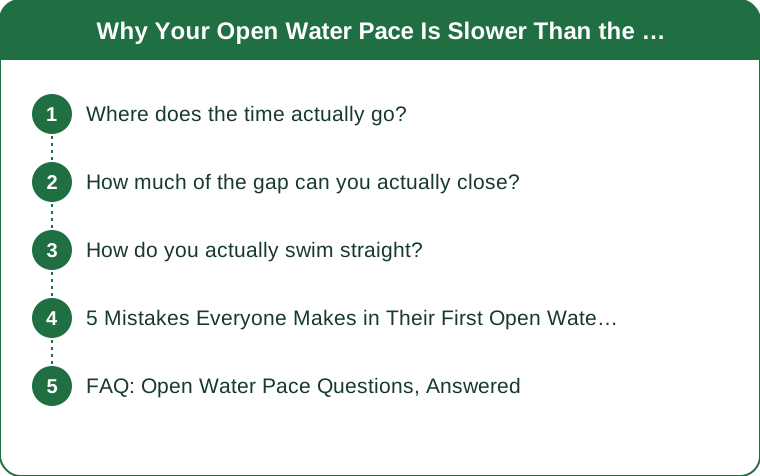
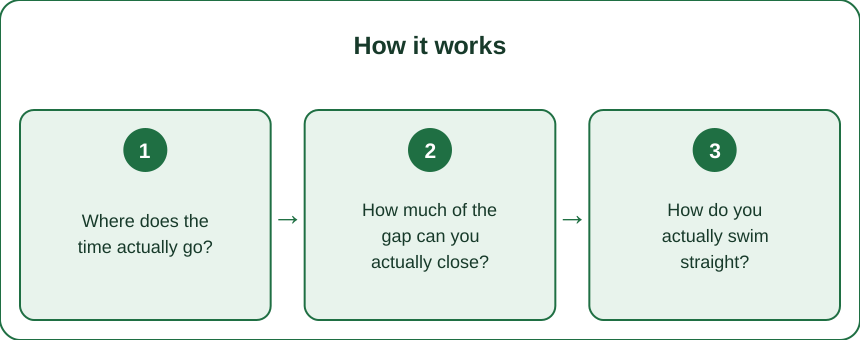
Where does the time actually go?
Six sources, roughly ordered by how much they cost a typical age-grouper.
Navigation error is usually the biggest single loss. Swimming 3-5% further than the course distance because you drifted is entirely normal for a first season. On a 1500m swim that is 45-75 extra metres — most of your apparent pace gap, right there, and it does not show on your watch as slowness.
Lost push-offs. In a 25m pool every length starts with a streamlined push and glide, which is faster than swimming. Over a 1500m pool swim that is 60 push-offs. In open water you get one, at the start. This alone accounts for several seconds per 100m and no amount of fitness recovers it.
Sighting disrupts body position. Lifting your eyes drops your hips, and the recovery back to a horizontal position costs more than the lift itself. Frequent sighting with poor technique compounds fast.
Wetsuit shoulder restriction. A wetsuit adds buoyancy — genuinely worth time — but restricts shoulder rotation and increases the effort of the recovery phase. A suit that is too tight in the shoulders can cost more than the buoyancy gives back.
Chop, current and cold. Water moving against you, over you and into your face all raise the effort of every stroke, and cold reduces contraction efficiency.
And the physical chaos of a mass start. Contact, feet in your face, other people’s turbulence. The first 200m of a race is rarely a clean swim.
How much of the gap can you actually close?
Realistically, most of the navigation loss and a good part of the sighting loss. Not the push-offs — those are gone.
Four training changes with the best return:
Practise sighting in the pool, every session. Two lifts per length, integrated into the stroke rather than as a separate head-up moment. The technique to drill: lift only the eyes to waterline, breathe to the side immediately after, keep kicking through the lift. Doing this in the pool means the movement is automatic before you are in cold water and adrenaline.
Do at least four open water sessions before your first race. Not for fitness — for the specific skills of picking a landmark, swimming a straight line, and being comfortable with no black line and no bottom.
Swim some pool sets without walls. Push off, then swim 100m of continuous work in a long-course pool if you have one, or do rope-and-turn-free sets. It changes what continuous swimming feels like.
Train in the wetsuit at least twice. Shoulder restriction is something you adapt to, and finding out in the race that your suit binds is the expensive way to learn.
How do you actually swim straight?
Straight-line swimming is a skill, not a talent, and five things build it.
Pick a big landmark, not the buoy. Buoys sit low and disappear in chop. A building, a tree line, a hill behind the buoy stays visible. Sight the big thing, confirm the buoy occasionally.
Sight every 6-10 strokes early, less often once you trust your line. More sighting is not better; each one costs. Find your minimum viable frequency in training.
Know your drift direction. Almost everyone consistently drifts one way, usually toward their dominant breathing side. Once you know yours, aim slightly off-line into it and you will track straight.
Breathe bilaterally when you can. Breathing only one side reinforces the asymmetry that causes the drift in the first place, and bilateral breathing lets you see other swimmers on both sides.
Use other swimmers carefully. Feet ahead of you are a good draft and an unreliable navigator. Following someone who is drifting means drifting with them — sight for yourself at least every third check.
5 Mistakes Everyone Makes in Their First Open Water Season
Going out at pool pace in the first 200m. Adrenaline plus contact plus cold means your first two minutes feel awful even at correct effort. Starting hard turns awful into panic. Start deliberately easy and build after the first buoy.
Wearing a wetsuit that fits like a pool costume. Too tight in the shoulders and you fatigue the arms early. It should be snug everywhere else and permit a full, unstrained shoulder rotation. A gap at the lower back that fills with water is a real drag penalty too.
Not testing goggles in the actual conditions. Bright sun on open water is completely different from indoors. Tinted lenses for a sunrise start facing east, clear for overcast — and anti-fog treatment applied the night before, not on the beach.
Treating cold water entry as a mental problem. The gasp response on cold water immersion is a reflex, not weakness. Get in early, put your face in, and let it pass before the start — it settles in a minute or two, but only if you have given it that minute.
And ignoring the exit. Standing up after 20 minutes horizontal makes many swimmers dizzy for a few seconds. Practise swimming until your hand touches the bottom, then standing slowly. It is a surprisingly common way to lose more time than the entire sighting deficit.
FAQ: Open Water Pace Questions, Answered
How much slower should open water be?
10-20% slower than pool pace is normal for age-group triathletes. Faster swimmers with good open water skills close it to under 10%.
Does a wetsuit make you faster?
Usually yes — the buoyancy improves body position substantially, especially for swimmers with heavy legs. A suit that restricts the shoulders can cancel that out.
How often should I sight?
Start at every 6-10 strokes and reduce it once you can hold a line. Every stroke is too many; once a length of the course is too few.
Why do I always drift the same direction?
Stroke asymmetry, usually linked to your dominant breathing side. Learn your direction and aim slightly against it.
Should I train in cold water?
Some exposure helps you handle the entry reflex, but never swim open water alone, and cold water carries real risks. Use a supervised session or a group, and talk to your clinician first if you have any cardiac history. This is general information, not medical advice.
How many open water swims before my first race?
At least four. The goal is skill and comfort, not fitness — 20-30 minutes each is plenty.
My watch says I swam further than the course. Is it wrong?
Probably not. GPS is imprecise on swims, but a 3-5% overage is genuinely common and usually real.
TL;DR:
- Open water runs 10-20% slower than pool pace, and most of it is mechanical, not fitness.
- The biggest loss is usually swimming further than the course — navigation, not speed.
- Drill sighting in the pool every session: eyes to waterline, breathe immediately after, keep kicking.
- Learn your own drift direction and aim slightly against it; breathe bilaterally where you can.
- Do four open water sessions minimum before your first race, at least two in the wetsuit.
Pick one thing this week: two sighting lifts per length in the pool. It is the cheapest minute you will ever find.
Keep Reading
This article is for general informational and styling purposes only. Fit, sizing, and product availability may vary.