The Race Belt Mistake That Costs You the Whole Run Leg
Quick Answer: Most race belt problems come from height, not tightness. Worn on the natural waist the belt sits on the part of your torso that flexes most while running and rides directly on wet skin, which is why it chafes. Sit it slightly lower, on the hip shelf rather than the soft waist, angle the number so it clears your thigh sweep, and fold the paper rather than crumpling it. Practise it once in training and it becomes invisible.
It is a five-dollar piece of elastic that ruins more run legs than nutrition does.
We have covered transition practice, wetsuit removal speed and race morning bag packing order. This is the smallest item in the box and one of the most reliably irritating.

Why does a race belt chafe so badly on the run?
Because it is sitting in the one place on your torso that never stops moving, on skin that is still wet.
Your natural waist flexes with every stride. The trunk rotates and side-bends slightly at each footfall, so a belt at that height is being dragged back and forth across skin thousands of times.
Wet skin has a far lower friction threshold. You have come out of the water, been rained on by aid station cups, and are sweating. Damp skin abrades in a fraction of the distance dry skin does.
Salt makes it worse as you dry. Sweat crystals on skin and fabric act as an abrasive, which is why the second half of the run is when most people notice it.
Tri suits are thin by design. There is very little fabric between the elastic and you, and the seams that do exist are usually placed for the bike position rather than the belt.
Most people compensate by tightening. A tighter belt moves less but presses harder, which trades a friction burn for a pressure line and usually delivers both.
And the number itself contributes. A stiff, crumpled paper edge sitting against skin or thigh is a cutting surface, particularly on the inside of the arm swing.
Where should the belt actually sit?
Lower than feels natural, and level rather than angled.
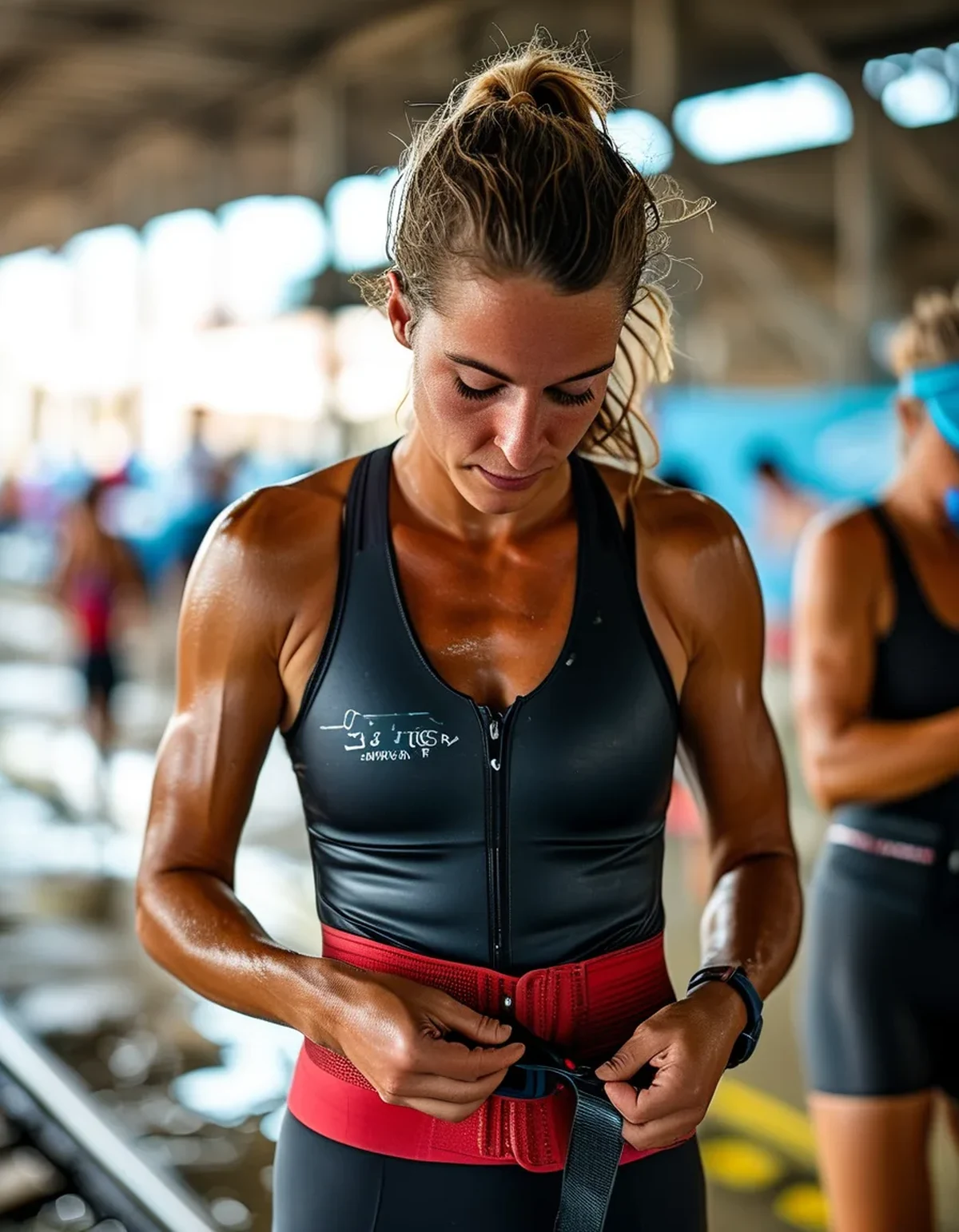
Aim for the top of the hip bones rather than the waist. The pelvis does not deform the way the waist does, so a belt resting there moves with you rather than against you.
Check it in the running position, not standing. Stand tall and it sits fine; lean into a run posture and a waist-height belt rides up under the ribs immediately.
Snug, not tight. You should be able to slide two fingers under it. If it needs to be tight to stay put, it is too high.
Rotate the number to the front before the run, not during. Spinning the belt while running twists the elastic and moves it upward, which is often the moment the trouble starts.
Angle the number slightly off-centre so the lower edge clears your thigh at the top of the stride. A number centred low on the abdomen catches the leg on every step.
And fold rather than crumple. Two or three deliberate accordion folds across the number keep it flexible without producing the sharp random creases a crumpled sheet gets. Race numbers need to be visible, not flat.
Myth vs Fact: Race Belts
Myth: A tighter belt chafes less because it moves less. Fact: Pressure and friction are separate problems and tightening trades one for the other. Correct height solves both; tightening solves neither.
Myth: You should crumple the number so it moves with you. Fact: Crumpling creates random sharp edges. Two or three clean accordion folds give the same flexibility without the cutting edges, and keep the number readable for officials.
Myth: Chafing is a body shape problem. Fact: It is overwhelmingly a placement problem. The same athlete with the same belt at hip height rather than waist height usually has no issue at all.
Myth: Anti-chafe balm is the fix. Fact: Balm buys you distance and it is genuinely worth applying, but it washes off in the swim and dilutes in sweat. It manages a placement error rather than correcting it.
Myth: You can sort the belt out in the first kilometre. Fact: The first kilometre off the bike is when your proprioception is worst and your hands are least useful. Whatever position you leave transition in is the position you will race in.
Myth: All race belts are the same. Fact: Width matters a lot. A wider, flatter elastic spreads load and chafes far less than a thin cord, and toggle-style closures sit flatter than plastic buckles under a tri suit.
A five-minute setup that makes the belt disappear
Six steps, done the evening before rather than in transition.
Thread the number on the night before and set the belt length to your race kit, not to whatever you wore last time. Kit thickness changes the fit more than people expect.
Fold the number in two or three vertical accordion pleats, then flatten it once. It should bend with your torso without crackling.
Apply anti-chafe balm along the hip line before the swim, not in T1. It survives the swim better than it survives being applied with wet hands under time pressure.
Leave the belt in T2 with the number already at the front, folded flat on your shoes. Clip it on and go. There is no reason to carry it on the bike unless the rules require it.
Set the height as you clip. Thumbs on the hip bones, belt on the thumbs. It takes a second and it is the whole difference.
Practise it once in a brick session. Ten minutes with the belt on in training tells you more than any amount of adjustment on race day.
One rules note: number visibility requirements vary by race and by federation, and some events require the number visible on the bike as well. Check the athlete guide rather than assuming, because a placement that feels perfect and earns a penalty is not a win.
FAQ: Race Belt Questions, Answered
Where should a triathlon race belt sit?
On the top of the hip bones rather than the natural waist. The pelvis does not flex the way the waist does, so the belt moves with you instead of dragging across skin. Snug enough to stay put with two fingers of room, and no tighter.
Do I need to fold my race number?
Folding helps it flex with your torso instead of crackling and catching. Use two or three clean accordion pleats rather than crumpling it, which creates sharp random edges. Keep the number readable, since officials need to be able to identify you.
Should I wear the belt on the bike?
Only if the race requires it. Otherwise leave it in T2 with the number already positioned at the front, so putting it on is one clip rather than a clip plus a spin plus an adjustment while your legs are still confused.
TL;DR:
- Race belt chafing is a height problem, not a tightness problem. Sit it on the hip bones, not the waist.
- Wet skin plus salt plus a flexing waistline is the whole mechanism.
- Fold the number in clean accordion pleats; crumpling makes cutting edges.
- Set it up the night before, leave it flat in T2, and practise it once in a brick.
The cheapest item in your transition box has more influence on how the run feels than most of the expensive ones.
Keep Reading
This article is for general informational and styling purposes only. Fit, sizing, and product availability may vary.