Your Saddle Height Is Deciding How Your Run Feels Off the Bike
Quick Answer: A saddle that is too high overworks your hamstrings and leaves you reaching at the bottom of the pedal stroke; a saddle that is too low keeps your hip flexors shortened under load. Both show up in the first mile off the bike. Test by lowering or raising in 2mm steps, one change per week, and judge it on a brick run rather than on the bike.
Everyone accepts jelly legs as the price of admission. You clip out, start running, and your legs belong to someone else for eight minutes.
Some of that is genuinely unavoidable - the transition from a seated, hip-flexed, 90rpm task to an upright, impact task is a real physiological switch.
But a meaningful chunk of it is your seatpost. And unlike your VO2 max, your seatpost changes in thirty seconds.

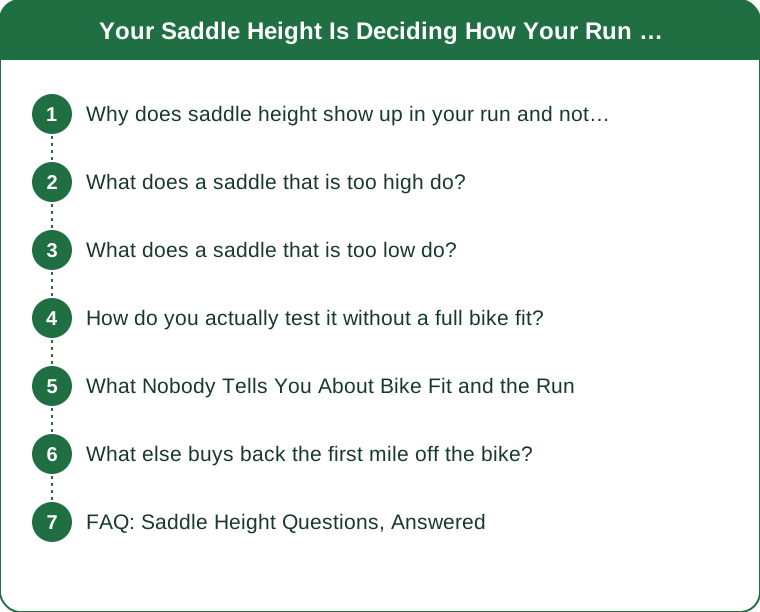
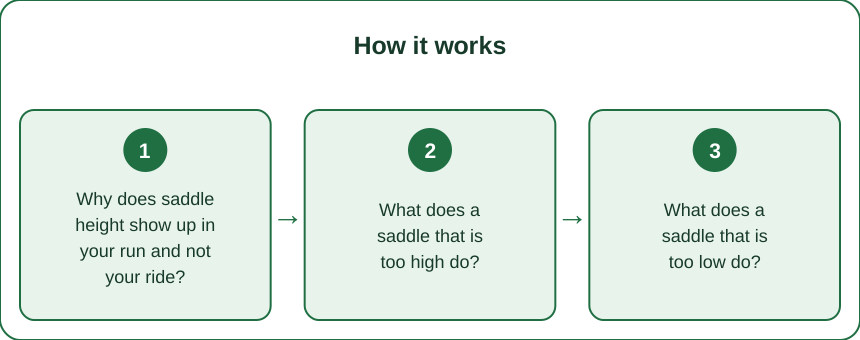
Why does saddle height show up in your run and not your ride?
Because cycling hides it. On the bike your hip flexors are shortened the whole time and never have to fully extend. You can ride for two hours in a position that has quietly restricted your hip extension and feel nothing but a strong ride.
Then you stand up and run, which demands full hip extension at every stride. The tissue that spent two hours at a shortened length does not lengthen on command, so your stride shortens, your cadence drops, and your glutes cannot fire properly.
That is the jelly-leg feeling for a lot of athletes. Not fatigue - a range-of-motion debt being called in at exactly the wrong moment.
What does a saddle that is too high do?
Too high makes you reach at the bottom of the stroke. The giveaways:
- Hips rocking side to side - the single clearest sign, and easy for a friend to spot from behind
- Pain or tightness at the back of the knee rather than the front
- Hamstring soreness that outweighs quad soreness after a long ride
- Toes pointing down to close the last few degrees
- Saddle soreness on one side, from rocking to compensate for a leg length difference
Off the bike, a too-high saddle usually reads as hamstrings that feel tight and short on the first mile of the run, and a stride that will not open up.
What does a saddle that is too low do?
Too low keeps the knee bent through the entire stroke, so your quads take a bigger share of the work and your hip never opens.
Signs on the bike: pain at the front of the knee, quads shredded relative to hamstrings, and a feeling of being cramped or scrunched on climbs.
Off the bike, it is the classic first-mile shuffle - a short, choppy stride that will not lengthen and a lower back that feels locked. Riders who are nervous about the height often creep the saddle down over a season without noticing, especially after a new pair of shoes or a cleat swap changes the effective height.

How do you actually test it without a full bike fit?
Change one thing, one time, and judge it on a brick:
- Mark your current height. A piece of tape on the seatpost or a caliper measurement from the bottom bracket along the seat tube.
- Move 2mm. Not 5mm, not a centimeter. Two millimeters is genuinely perceptible at 5,000 pedal strokes and is small enough to be safe.
- Ride your normal 60-90 minute session, then run 10 minutes immediately off the bike.
- Score the first 800 meters of the run, not the ride. Stride length, cadence, and whether your hips feel open.
- Hold it a week before changing again. One variable, one week.
A practical starting reference: with your heel on the pedal at the bottom of the stroke and your hips level, your leg should be almost straight with a very slight bend. That gets you close enough to start the 2mm search.
What Nobody Tells You About Bike Fit and the Run
Fit changes that make you faster on the bike sometimes make you slower over the whole race. A more aggressive, lower, more closed hip angle can genuinely improve aerodynamics - and cost you the first two miles of the run.
For most age-group athletes, the run leg is longer in time than the bike advantage is worth. If a position saves you 90 seconds on the bike and costs you three minutes on the run, it is a bad position for a triathlon even though it is a good position for a time trial.
The other unspoken thing: your fit is seasonal. Hip mobility in April after a winter of desk work is not hip mobility in August after four months of riding. A saddle height that was correct in spring is often 2-3mm low by late summer.
And cleat wear counts. Worn cleats effectively raise your saddle by a couple of millimeters. New cleats mid-season are a fit change whether you meant one or not.
What else buys back the first mile off the bike?
Three things stack on top of a correct saddle height:
- Spin down the last 5-8 minutes of the bike leg at higher cadence and lower resistance. It shifts the muscle recruitment toward what the run needs.
- Stand and pedal for 20 seconds twice in the final mile. That opens the hips before you have to run on them.
- Practice the transition run at race effort, not jog effort. The adaptation is specific - brick runs done easy do not prepare you for the sensation of brick runs done hard.
This is general information, not medical advice. Persistent knee pain from a bike position is worth a professional fit and a sports medicine opinion rather than another 2mm.
FAQ: Saddle Height Questions, Answered
How do I know if it is fit or just fitness?
Fitness fades gradually across the run. A fit problem shows up in the first 400 meters, feels like restriction rather than fatigue, and often improves by mile two once your hips open up.
Should I change my saddle height in race week?
No. Any fit change needs at least two weeks and one long brick before you trust it. Race week is for the position you have already trained on.
Does saddle fore-aft matter as much as height?
It matters differently. Fore-aft changes the effective height too, so a saddle moved back is also a saddle raised. Change one axis at a time or you will not know which one helped.
TL;DR:
- Cycling hides saddle height problems; the first mile of the run exposes them.
- Too high means hip rocking, hamstring dominance, and back-of-knee tightness. Too low means front-of-knee pain and a stride that will not open.
- Test in 2mm steps, one change per week, and judge on the first 800 meters of a brick run.
- Cleat wear and seasonal mobility both move your correct height by a few millimeters.
- Spin down and stand twice in the last mile of the bike to buy back the transition.
Jelly legs are partly the sport and partly your seatpost. The seatpost is the half you can fix this week, and 2mm is a smaller investment than any workout you were going to do instead.
Keep Reading
This article is for general informational and styling purposes only. Fit, sizing, and product availability may vary.