Why the Bike-to-Run Transition Feels Worse Than Your Training Predicted
Quick Answer: The heavy-legged feeling off the bike comes from blood pooling in the legs, a cycling-specific muscle recruitment pattern that has to be reset, and cadence mismatch. It typically resolves in 8 to 12 minutes. Brick training, a higher final cycling cadence, and a deliberately slow first kilometer all shorten it.
You trained both disciplines. Your run is solid and your bike is solid.
Then you racked the bike, started running, and your legs belonged to someone else for the first mile — someone significantly less fit than you.
Everyone experiences this. Not everyone knows it is largely mechanical and largely manageable.

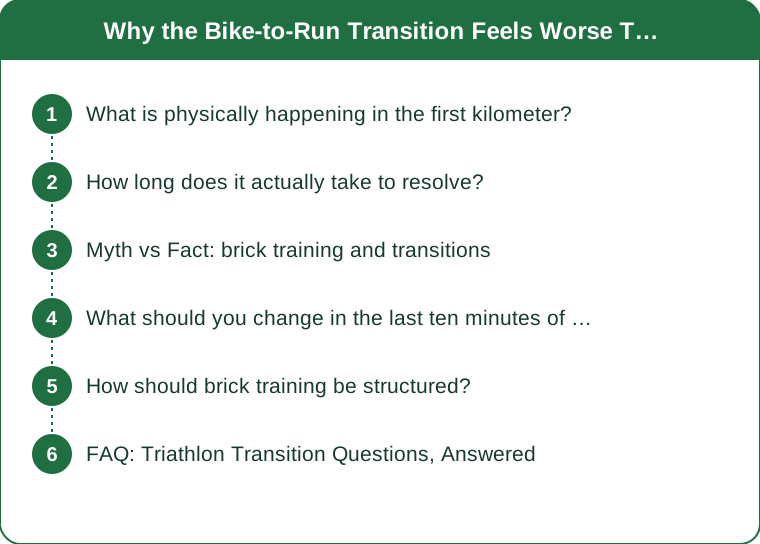
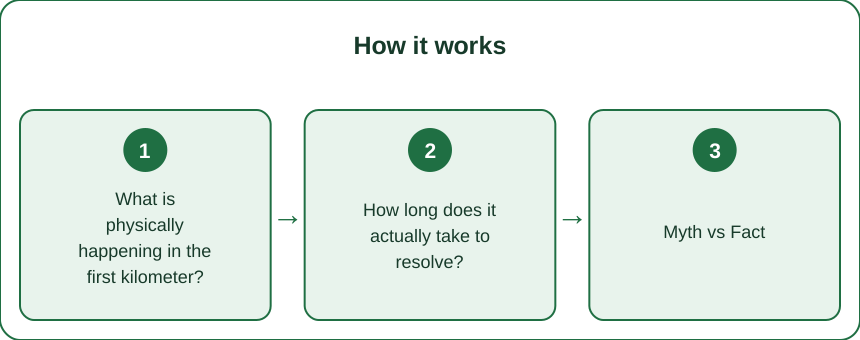
What is physically happening in the first kilometer?
Three things at once.
Blood distribution. Cycling in a fixed, seated, forward position with legs below the heart promotes venous pooling in the lower limbs. Standing up and running changes the demand suddenly, and it takes several minutes for distribution to normalize.
Muscle recruitment mismatch. Cycling emphasizes the quadriceps in a concentric-dominant, fixed-path pattern with essentially no eccentric loading and no impact. Running requires eccentric loading through the quads and calves, significant hamstring and glute involvement, and impact absorption on every stride. Your nervous system has spent an hour optimizing for one pattern and has to switch.
Cadence conflict. Cycling cadence is typically 80 to 95 rpm, which is roughly 160 to 190 leg movements per minute. Running cadence is often similar in number but completely different in movement pattern, and the neuromuscular carryover produces the choppy, short-strided feeling most athletes describe in the first few minutes.
How long does it actually take to resolve?
For most trained athletes, the acute heaviness resolves in 8 to 12 minutes — roughly the first mile to mile and a half.
Athletes who train bricks regularly report a shorter window, often 4 to 6 minutes. Athletes who have never done a brick sometimes report it lasting most of a 5K, which is long enough to wreck a race.
The key insight for racing is that the transition period is survivable and temporary, and how you handle those first minutes largely determines the rest of the run. Athletes who panic at the heaviness and push harder to compensate spike their heart rate and pay for it at mile three. Athletes who accept a slow first kilometer usually find their normal pace arrives on its own.
This is why experienced triathletes often deliberately run the first kilometer 20 to 30 seconds slower than goal pace. It is not caution — it is the fastest overall strategy.
Myth vs Fact: brick training and transitions
Myth: You need long brick workouts to adapt. Fact: A 15 to 20 minute run off the bike delivers most of the adaptation. The transition itself is the stimulus; extending the run just adds fatigue. Short bricks, done frequently, beat rare long ones.
Myth: Heavy legs mean you biked too hard. Fact: Pacing certainly matters, but the sensation occurs even after an easy ride. It is a pattern-switching cost, not purely a fatigue cost.
Myth: Stretching in transition helps. Fact: Static stretching in T2 does nothing useful and costs time. Movement is what redistributes blood flow — get running slowly rather than standing still.
Myth: Your run split is determined by your run fitness. Fact: In triathlon it is heavily determined by bike pacing. Riding at an intensity that leaves adequate glycogen and avoids deep fatigue matters more to your run split than most run-specific training does.

What should you change in the last ten minutes of the bike?
This is where the transition is actually won, and it is the most underused window in the race.
Raise your cadence, lower your gear. In the final 5 to 10 minutes, shift to an easier gear and spin at 95 to 100 rpm. This reduces muscular load, clears some accumulated fatigue, and primes a faster leg turnover that carries into the run.
Stand and pedal briefly, two or three times. Twenty seconds each. It changes muscle recruitment, restores some blood flow, and reintroduces your body to being upright before you have to run.
Take in fluid and calories. The last few minutes on the bike are the easiest place to consume anything. Running with a full stomach is far worse than drinking on the bike.
Loosen the shoes and prepare mentally. Whatever you can do while still moving saves time and reduces the standing-still period that makes the transition worse.
These four things together shorten the heavy-leg window noticeably, and they cost almost nothing in bike split.
How should brick training be structured?
Frequency and specificity matter more than volume.
Weekly short brick. After a normal bike session, run 15 to 20 minutes at easy to moderate effort. The transition should be fast — under 3 minutes — because the abruptness is the stimulus.
Monthly race-simulation brick. Bike at goal race intensity for a substantial block, then run 20 to 30 minutes at goal race pace. This is the session that tells you whether your bike pacing plan is realistic.
Practice the actual transition. Rack the bike, change shoes, put on a hat — the whole sequence. Transition skills are worth 1 to 3 minutes of race time and are the cheapest improvement in the sport.
Add running-specific strength. Single-leg work, calf raises, and eccentric loading through the quads. Cycling does not build the eccentric capacity running demands, so cyclists moving into triathlon are frequently underprepared there specifically.
Do not overdo bricks. They carry more fatigue cost than either discipline alone. One to two per week is plenty for most athletes, and a heavy brick block is a common route to overreaching.
This is general information, not medical advice. Persistent pain in transition running, particularly in the shins or knees, is worth evaluating rather than training through.
FAQ: Triathlon Transition Questions, Answered
Should I run in socks or without?
Without, for sprint and Olympic distance, if your shoes are set up for it and your feet tolerate it — it saves 20 to 40 seconds. For half and full distance, wear socks; the blister risk over that duration outweighs the time saved.
Why do my calves cramp specifically in T2?
Common and multifactorial: cycling in a plantarflexed position, sudden change to impact loading, and often electrolyte and hydration status. Raising bike cadence at the end and taking in sodium during the ride both help.
Is the heavy feeling worse in longer races?
Proportionally it is often less noticeable, because the run is long enough that the first mile is a small fraction of it — but the underlying fatigue is greater. In sprint distance the transition window is a large share of the whole run, which is why brick training matters most at short distance.
Can I eliminate the sensation entirely?
No, and even elite triathletes report it. What consistent brick training does is shorten it and make it familiar enough that it stops being alarming — which is most of the practical benefit.
TL;DR:
- Heavy legs come from venous pooling, a cycling-to-running recruitment switch, and cadence mismatch.
- It typically resolves in 8–12 minutes, or 4–6 for athletes who train bricks regularly.
- Spin at 95–100 rpm in the last 5–10 minutes of the bike, stand a few times, and fuel before T2.
- Run the first kilometer 20–30 seconds slower than goal pace — it is the faster overall strategy.
The legs that felt borrowed for the first mile were never a sign your run training failed. They were a pattern switch in progress, and it is one of the few things in triathlon that gets reliably better with a fifteen-minute session once a week.
Keep Reading
This article is for general informational and styling purposes only. Fit, sizing, and product availability may vary.